

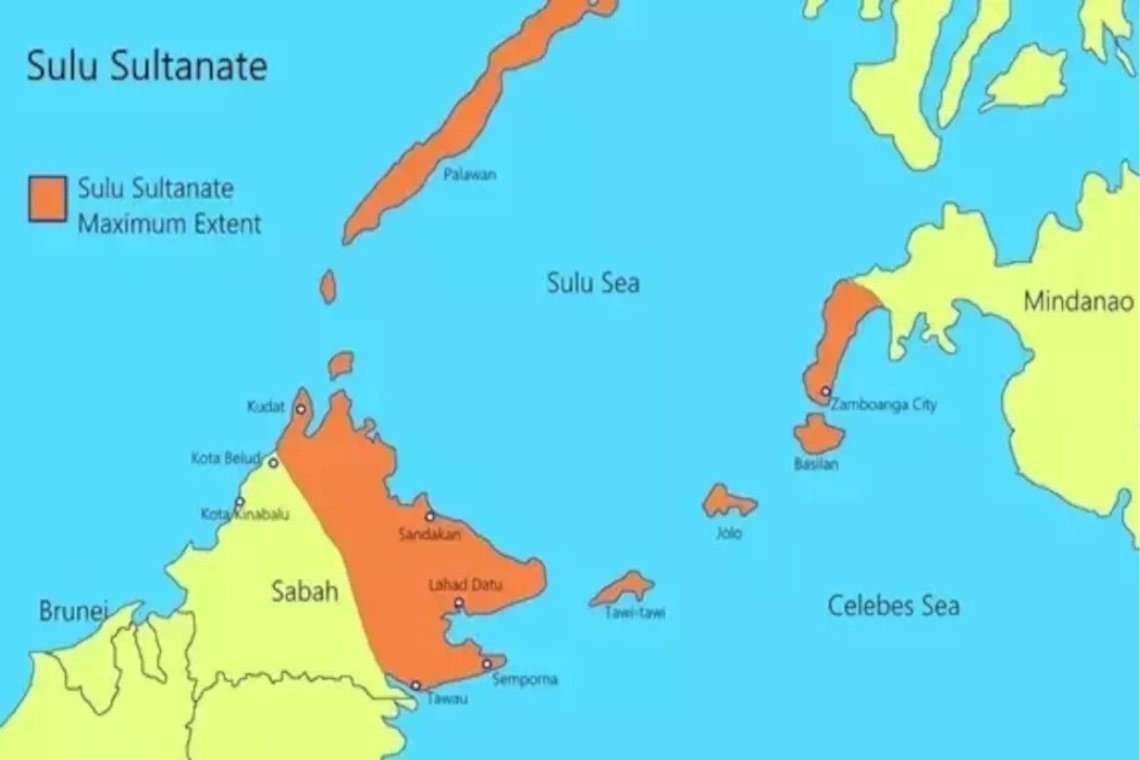
Historical map illustrating the Sulu Sultanate’s maritime sphere and its historical connections with northern Borneo and Mindanao. Image Source: The Kahimyang Project.
Long before Sabah became a Malaysian state, the waters between the Sulu Archipelago and northern Borneo formed part of an interconnected political and commercial world. Ships, traders, local rulers and maritime communities moved across routes linking Jolo, Tawi-Tawi, Mindanao and the eastern coast of Borneo. These connections were not defined by the modern boundaries separating the Philippines and Malaysia.
The Sultanate of Sulu occupied an important position within this regional system. Its authority developed through political relationships, trade and alliances with communities across the surrounding islands and coastal territories. The historical relationship between Sulu and northern Borneo, therefore, provides essential context for understanding the origins of the present Sabah claim.
The dispute, however, cannot be understood through historical connections alone. The arrival of European colonial powers, the 1878 agreement involving the Sultan of Sulu and the establishment of modern states fundamentally changed the political geography of the region.
The Sultanate of Sulu emerged as a major political power in the southern Philippines during the fifteenth century. Its influence extended beyond the islands surrounding Jolo, reaching communities and settlements connected to northern Borneo, southern Palawan and other parts of the Sulu Sea. Geography played a central role in this development. The Sulu Archipelago occupied a strategic position between Mindanao and Borneo, allowing maritime communities to participate in commercial exchanges across Southeast Asia. Tausug, Sama-Bajau, Iranun, Bugis and Chinese traders contributed to an economic environment shaped by navigation, fishing, regional commerce and the exchange of local products.
The Sultanate also maintained political relationships with local leaders through alliances, tribute arrangements and other forms of association. However, influence over coastal communities did not necessarily correspond to the continuous administration of territory according to modern state boundaries.
These historical connections also remain visible in the cultural identities of communities on both sides of the Sulu Sea. Suluk and Bajau populations in Sabah have longstanding social, economic and cultural links with the Sulu Archipelago, reflecting patterns of mobility that predate modern national borders. However, these shared histories have become more complicated under contemporary migration policies, as people with historical ties to the region may also face questions surrounding citizenship, legal status and belonging. The distinction between historical mobility and present-day immigration is therefore essential to understanding the legacy of the Sulu-Sabah relationship.
“The Sultanate of Sulu emerged as a major political power in the southern Philippines during the fifteenth century.”
For the Sulu-Sabah question, this distinction is particularly important. Historical relationships between the Sultanate and northern Borneo help explain why the region became part of Sulu's political and economic history. They also demonstrate why the later territorial dispute cannot be separated from the maritime history of the wider region.
Updated headlines for free, straight to your inbox—no noise, just facts.
We collect your email only to send you updates. No third-party access. Ever. Your privacy matters. Read our Privacy Policy for full details.
The nineteenth century brought increasing competition between European powers for influence over Southeast Asian trade routes and territories. British commercial interests expanded in northern Borneo, while Spain attempted to strengthen its position in the Sulu Archipelago. On January 22, 1878, Sultan Jamalul Alam of Sulu entered into an agreement with Gustavus Baron von Overbeck and Alfred Dent, representatives of British commercial interests. The agreement concerned extensive territories in northern Borneo and provided for an annual payment of 5,000 dollars to the Sultan and his successors. The document became the foundation of the modern Sulu-Sabah dispute because its interpretation remains contested. The English translation used by the British side described the arrangement through the language of grant and cession. The interpretation advanced by the Philippine side understood the transaction as a lease, meaning that territorial sovereignty had not been permanently transferred.
The difference between these interpretations is central to the historical argument behind the Sabah claim. If the agreement represented a lease, the Sultanate's successors could argue that the arrangement did not eliminate the original territorial rights. If it represented a permanent cession, the legal consequences would be substantially different.
“The interpretation advanced by the Philippine side understood the transaction as a lease, meaning that territorial sovereignty had not been permanently transferred.”
The political context also changed rapidly. The British North Borneo Company was established following the commercial arrangements and received its royal charter in 1881. The company subsequently administered the territory under British authority, transforming an area previously connected to regional political relationships into a colonial administrative territory. Another important development occurred in 1885. Under the Madrid Protocol, Spain renounced its claims against Britain over territories in Borneo that belonged or had previously belonged to the Sultan of Sulu. The agreement also recognized Spanish sovereignty over the Sulu Archipelago in the context of European colonial negotiations. The protocol is significant because it explicitly referred to territories historically associated with the Sultan of Sulu. Nevertheless, it was an agreement between European powers and did not independently resolve the competing interpretations of the Sultan's 1878 agreement.
The end of the nineteenth century brought another transformation. Spain transferred the Philippines to the United States following the 1898 Treaty of Paris. Sulu consequently entered a new colonial administrative framework, while northern Borneo followed a different political path under British control. This separation gradually replaced the older regional connections with distinct administrative and political systems. Communities with longstanding commercial, cultural and family relationships across the Sulu Sea increasingly found themselves living under different colonial authorities.
After the Second World War, British North Borneo became a British Crown Colony in 1946. The emergence of independent states subsequently introduced another dimension to the dispute. In 1962, during the administration of Philippine President Diosdado Macapagal, the Philippines formally advanced its claim to North Borneo. The argument relied partly on the historical position of the Sultanate of Sulu and the Philippine government's assertion that it had inherited the relevant rights.
In 1963, Sabah became part of the newly established Federation of Malaysia. The Philippines did not accept the Malaysian position on the territorial question, and the dispute remained an issue in relations between Manila and Kuala Lumpur. The historical claim also continued to evolve beyond the original governments involved in the 1878 agreement. The Sultanate's heirs and representatives maintained different positions concerning the agreement, the annual payment and the rights associated with the historical territory.
The historical agreement of 1878 has continued to influence legal disputes long after the colonial arrangements that produced it disappeared. In 2013, Malaysia stopped making the annual payments associated with the agreement following the armed incursion into Sabah led by supporters of self-proclaimed Sultan Jamalul Kiram III. In 2017, individuals claiming to be heirs of the Sultanate initiated arbitration proceedings against Malaysia, arguing that the historical agreement entitled them to compensation. The case eventually produced a controversial award of approximately US$14.92 billion in February 2022.
The legal developments since then have significantly changed the position of the claimants. On December 9, 2025, the Paris Court of Appeal annulled the final arbitral award in its entirety, finding that the arbitrator lacked jurisdiction because no valid arbitration agreement could bind Malaysia. In November 2025, a separate investment claim brought by members of the group against Spain was also dismissed by an ICSID tribunal. These decisions represent major setbacks for the heirs' legal campaign, although they should not be confused with a final resolution of the Philippines' separate territorial claim over Sabah.
Despite the setbacks faced by the Sultanate's heirs in international arbitration, the broader Sabah question remains part of Philippine foreign policy. On February 20, 2026, the Philippine Department of Foreign Affairs reaffirmed the country's sovereignty claim over Sabah, stressing that Republic Act No. 12064, the Philippine Maritime Zones Act of 2024, had not repealed the provision in Republic Act No. 5446 preserving the country's existing claims over North Borneo. This distinction highlights the different paths followed by the historical claim: the heirs' compensation dispute has suffered major judicial defeats, while the Philippine government continues to maintain its separate territorial position.
For communities in Sulu, the significance of this history extends beyond diplomatic exchanges. The Sulu Sea continues to connect the southern Philippines and northern Borneo through shared maritime traditions, family histories and cultural practices. These connections form part of Sulu's historical identity, even as modern borders and immigration policies have reshaped how communities interact across the region.
“For communities in Sulu, the significance of this history extends beyond diplomatic exchanges.”
The preservation of Sulu's historical identity has also gained renewed visibility in recent cultural initiatives. From July 27 to 29, 2026, the Bangsamoro Government presented an exhibition titled "Sulu's Historical Legacy and Cultural Heritage" at the History to Experience (HistoEx) event in Pasay City. Organized by the National Historical Commission of the Philippines, the exhibition featured historical photographs, traditional crafts, clothing and local food, highlighting Sulu's contributions to regional diplomacy, trade and cultural exchange. Such initiatives demonstrate how the Sultanate's legacy continues to be preserved as part of the region's broader historical identity, independently of the unresolved political questions surrounding Sabah.
The historical relationship between Sulu and Sabah cannot be reduced to a single territorial dispute. It reflects centuries of maritime exchange, political relationships and cultural connections that developed before modern borders divided the region. Although recent court decisions have weakened the legal campaign pursued by the Sultanate's heirs, the Philippine government's continued position on Sabah demonstrates that the historical question remains politically relevant. For Sulu, preserving this legacy also means recognizing the communities, traditions and shared maritime history that continue to connect the region with northern Borneo.
REFERENCES
Melayu: Jurnal Antarabangsa Dunia Melayu. (2016, July 2). The claim over Sabah by the Sultanate of Sulu. A revision from historical and legal perspectives. Melayu: Jurnal Antarabangsa Dunia Melayu. https://jurnal.dbp.my
Taylor & Francis Online. (2026, March 11). Diplomatic claims and imperial realities: Spain and Northern Borneo in the nineteenth century. Taylor & Francis Online.
Wiley.Online Library. (2026, May 18). Commercial treaties and political transformation in Sulu and Southeast Asian littorals, c. 1830–1840. Wiley.Online Library.
https://onlinelibrary.wiley.com
Springer Nature Link. (2025, September 23). Sea nomads, sultans, and raiders. History and ethnogenesis in the Sulu Archipelago, Philippines. Springer Nature Link.
Cambridge University Press. (2011, March 23). Historical notes on the North Borneo dispute. Cambridge University Press.
Teramura, N., & Nottage, L. (2026, October 7). The Heirs to the Sultanate of Sulu v Malaysia: Arbitration as friend or foe? Arbitration International.
Bangsamoro Information Office. (2026, July 29). Sulu's living heritage takes national spotlight at HistoEx 2026 in Pasay City. Bangsamoro Information Office.
Taylor & Francis Online. (2025, January 7). Territorial claims, unclaimed people: The postcolonial geopolitics of statelessness in Sabah, Malaysia. Taylor & Francis Online.

KnowSulu is your trusted source for verified facts, news, and legal insights about the Sulu region. Committed to integrity, our mission is to empower the people of Sulu by providing accurate, transparent, and reliable information that matters.