

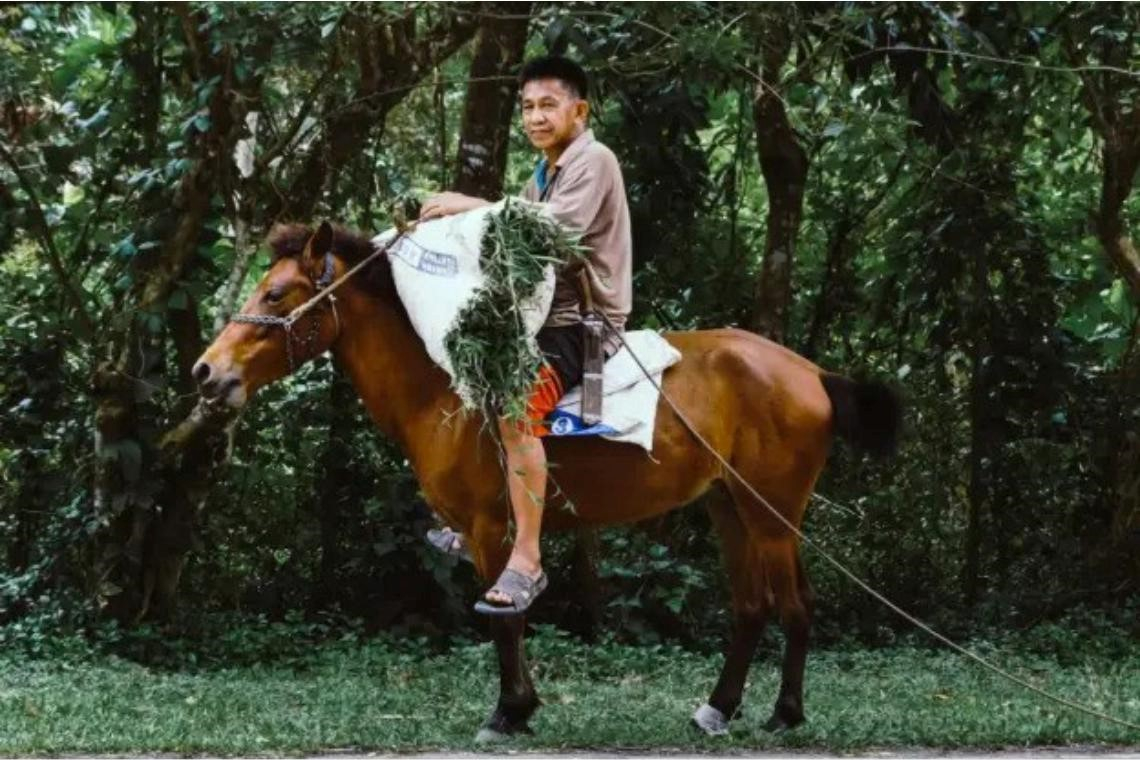
A Philippine Pony, a resilient native breed descended from horses left behind by visiting Chinese, Brazilian, and South American traders. Image Source: Equinest.
The Sulu Archipelago has a documented history of horse breeding, riding, and organized competition. Horses moved through maritime networks connecting the southern Philippines with neighboring parts of Southeast Asia, and successive breeding practices shaped the animals found across the region. By the early twentieth century, horse racing had become an established recreational activity in Sulu, supported by a local association and dedicated racing tracks. This history reveals how horses contributed to sporting life in the province and connected its communities to a wider tradition of equestrian competition.
Horses reached the southern Philippines through exchanges connecting the archipelago with neighboring parts of Southeast Asia. Trade and regional contact brought different animals into the islands, while successive breeding practices contributed to the development of native Philippine horses. Historical descriptions distinguish the smaller ponies associated with Sulu from horses introduced through other regional and colonial networks. Sulu-bred horses were described as compact, agile, and sure-footed. Some historical accounts associated them with Arabian ancestry, although the precise ancestry of individual horses varied. Their ability to move across uneven terrain made them suitable for riding and outdoor pursuits. These characteristics also help explain the value placed on horses in communities where mobility across difficult landscapes was important.
“Sulu-bred horses were described as compact, agile, and sure-footed.”
Horses associated with Sulu also contributed to the early development of organized racing in the Philippines. When the Manila Jockey Club was established in 1867, Philippine ponies of Suluan, Indian, and Chinese descent were among the animals associated with the country's early racing scene. These native horses preceded the later dominance of imported thoroughbreds in formal competition. The history of Sulu's horses, therefore, extends beyond the archipelago itself. Their presence in early Philippine racing connects local breeding traditions with the evolution of a national sporting industry. At the same time, the characteristics attributed to native ponies preserve a distinct part of the southern Philippines' equestrian history.
Updated headlines for free, straight to your inbox—no noise, just facts.
We collect your email only to send you updates. No third-party access. Ever. Your privacy matters. Read our Privacy Policy for full details.
Horse racing was an established recreational activity in Sulu during the early twentieth century. Races involving horses and carabaos formed part of the province's sporting life, attracting interest in displays of speed, strength, and skill. A racetrack was established near Jolo by the Sulu Racing Association, which sought to encourage the breeding of better horses while providing recreation for local residents. Additional tracks were subsequently reported in other parts of the province. The association's activities demonstrate that horse racing in Sulu had an organized dimension. Dedicated facilities offered places for competitions and supported efforts to improve local horses. Racing was therefore connected not only to entertainment but also to breeding and the development of animals suited to local conditions.
“A racetrack was established near Jolo by the Sulu Racing Association, which sought to encourage the breeding of better horses while providing recreation for local residents.”
Beyond racing, horses were used for riding and hunting. Their ability to navigate rocky ground and uneven terrain made them valuable for journeys beyond established roads. Horsemanship also required familiarity with animal handling, riding techniques, and the demands of working with horses in different environments. Manila provides a brief comparison. Organized racing began there in the nineteenth century, initially as a recreational pursuit. Sulu, however, developed its own association and racing facilities, demonstrating that the southern province had a distinct place in the history of Philippine equestrian sport.
Horse racing has also featured in efforts to revive traditional sporting activities in Jolo. Sports festivals described in historical accounts of the region included horse racing alongside other traditional competitions, such as boat races and bullfights to keep the tradition alive for younger generations. These initiatives ensure that the historical connection between the Tausug people and their horses remains an active part of local cultural heritage.
“Horse racing has also featured in efforts to revive traditional sporting activities in Jolo.”
The Tausug expression Lumbaan Kura may also offer a linguistic connection to this heritage. The word kura’ means “horse” in Tausug, a term related to the Malay word kuda. The complete expression is commonly presented as referring to a horse-racing ground, but it also refers to the festive horse-racing event itself, where community members gather during traditional celebrations and local holidays. Derived from the root word lumba, meaning competition or race, Lumbaan Kura’ reflects both the physical open grounds used for equestrian matches and the historical gatherings that showcased Tausug riding skills across the Sulu Archipelago. While modern motor vehicles have largely replaced horses for daily travel across Jolo and nearby islands, horsemanship remains an enduring symbol of Tausug cultural identity and historical resilience in the Sulu Archipelago.
REFERENCES
Taylor&Francis Online. (2015, April 28). Bestia incognita: The horse and its history in the Philippines 1880–1930. Taylor&Francis Online. https://www.tandfonline.com
Gutenberg. (1880). The gardens of the sun: A naturalist’s journal on the mountains and in the forests and swamps of Borneo and the Sulu Archipelago. Gutenberg. https://www.gutenberg.org
Philippine Jockey Club. (n/a). Our heritage. Philippine Jockey Club. https://pjcracing.com
Sulu Archipelago and its People. (1931). The Sulu Archipelago and its people. Sulu Archipelago and its People. https://suluarchipelagoanditspeople.wordpress.com
Studylib. (1985, February 8). Jolo, Sulu: Restoring history in the southern Philippines. Studylib. https://studylib.net

KnowSulu is your trusted source for verified facts, news, and legal insights about the Sulu region. Committed to integrity, our mission is to empower the people of Sulu by providing accurate, transparent, and reliable information that matters.