

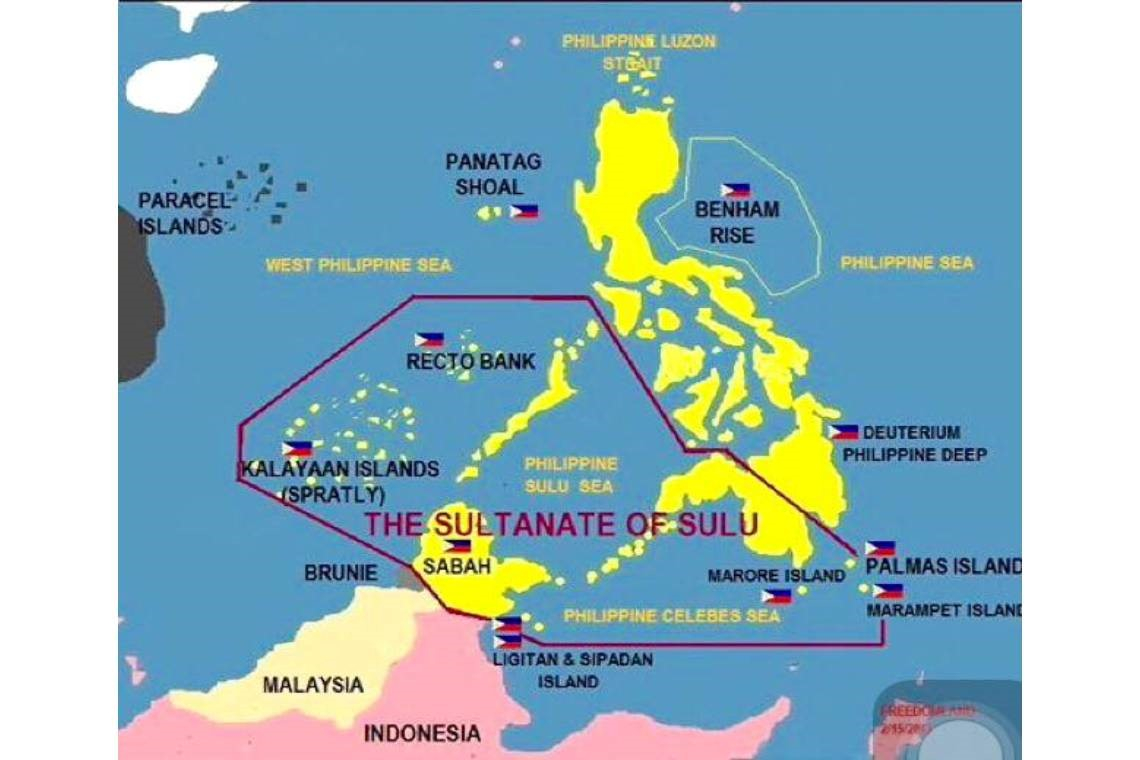
The Philippines actively defends its claims in the West Philippine Sea. The disputed boundaries of the historical Sulu Sultanate have contributed to these claims. While the Philippines’ interest in the country’s dormant claim to Malaysia’s Sabah state is varied, tensions arising from the Sulu arbitration and nationalist sentiments across the region have the potential to escalate the matter. Source: Facebook, The Spratly Islands, Scarborough Shoal and Sabah, Philippines
The Atin Ito coalition recently launched a mission on jetskis to Pag-asa Island Cay 2, where participants planted the Philippine flag in defiance of Beijing’s claims in the South China Sea. China predictably objected to the activity in the disputed waters, but another important aspect was reported on by Franco Jose C. Baroña of The Manila Times: among the participants was Akbayan Representative Dadah Kiram Ismula, a purported member of the House of Kiram.
That association is difficult to ignore given the long-running political behavior of various Kiram claimants. Descendants and self-styled heirs of the old Sulu Sultanate have spent years advancing historical narratives tied to Malaysia’s Sabah state, territory the Sultanate once exercised limited influence over. Their campaigns have often wrapped themselves in nationalist rhetoric and appeals to sovereignty. Yet the same figures have also shown remarkable flexibility when it comes to inviting foreign involvement—particularly from China.
Whether the Spratly Islands were ever truly part of the Sulu Sultanate remains disputed and historically unsettled. Nonetheless, a spokesperson for Fuad A. Kiram once claimed that the Spratlys belonged to the Sultanate in the same manner as Palawan and North Borneo.
“Yet the same figures have also shown remarkable flexibility when it comes to inviting foreign involvement—particularly from China.”
Fuad Kiram is already well known as the public face of the Sulu arbitration campaign against Malaysia. But his camp has also produced statements that sharply undercut the nationalist posture often associated with the Kiram cause. In a November 2024 statement, his legal team reportedly suggested the possibility of “leasing” Sabah to foreign powers, including China.
“In a November 2024 statement, his legal team reportedly suggested the possibility of “leasing” Sabah to foreign powers, including China.”
The proposal was striking not only because it treated Sabah as though it were private family property, but because it openly entertained cooperation with a country engaged in a prolonged territorial confrontation with the Philippines.
The contradictions did not stop there. A separate letter circulated online in December 2025 under the name “Sultanate of Sulu De Jure Government” called for a diplomatic reset with China and even proposed joint military ventures.
This makes Ismula’s appearance on a mission opposing Chinese claims look less like principled nationalism and more like selective opportunism. The Kiram movement frequently draws support in the Philippines from nationalist sentiment, yet some of its most visible personalities have shown little hesitation in courting Chinese involvement when it appears useful to their own Sabah agenda.
“This makes Ismula’s appearance on a mission opposing Chinese claims look less like principled nationalism and more like selective opportunism.”
Updated headlines for free, straight to your inbox—no noise, just facts.
We collect your email only to send you updates. No third-party access. Ever. Your privacy matters. Read our Privacy Policy for full details.
The inconsistency is difficult to overlook. What emerges is the impression that the guiding principle is not national interest, but the shifting political and personal interests of rival Kiram factions.
Even the question of who actually represents the “House of Kiram” is deeply muddled. According to The Manila Times, Princess Jacel Kiram has publicly distanced her family from Ismula, insisting neither she nor her actions have any connection to their branch of the lineage. Far from clarifying matters, the dispute only underscores the fragmentation that has long defined the Sulu succession issue. Competing claimants continue to present themselves as heirs to a Sultanate that no longer governs anything at all.
“Princess Jacel Kiram has publicly distanced her family from Ismula, insisting neither she nor her actions have any connection to their branch of the lineage.”
Jacel Kiram is also not without controversy. She is the daughter of Jamalul Kiram III, the self-proclaimed Sultan behind the 2013 Lahad Datu incursion into Sabah. That armed operation left dozens dead, destabilized relations between Malaysia and the Philippines, and demonstrated the dangers of dynastic politics wrapped in nationalist language.
Yet Jamalul’s line has never been formally recognized by any government as the legitimate continuation of the Sulu Sultanate.
The same lack of recognition applies to Fuad A. Kiram despite his prominence in the arbitration campaign and reported links to figures associated with the Lahad Datu episode.
The claimant generally regarded as the closest thing to a legitimate heir today is Muedzul Lail Tan Kiram, son of Mohammad Mahakuttah Kiram, the last Sultan formally recognized by the Philippine government during Ferdinand Marcos Sr.’s administration in the 1970s.
Muedzul has continued to assert Sabah claims, but unlike Jamalul’s faction, he publicly rejected armed confrontation during the 2013 incident and called instead for dialogue.
Still, the wider spectacle surrounding the Kiram claimants increasingly resembles less a coherent royal house than a collection of competing personalities unable to agree on lineage, legitimacy, or even foreign policy. The “House of Kiram” today appears united mainly by its opportunism and inability to decide what it represents.
REFERENCES
Baroña, F. J. C. (2026, May 7). Kiram family distances from lawmakers jetski move in West Philippine Sea. The Manila Times. https://www.manilatimes.net
Dacanay, BM (15 September 2018). Spratly Islands long part of Filipino Muslims’ ancestral domain. Gulf News. https://gulfnews.com
KnowSulu (30 March 2026). Jersey court hears conspiracy claim over conduct in failed Sulu arbitration
KnowSulu (16 October 2025). Plotting a lease of Sabah: The Sulu heirs-China gambit. Know Sulu. https://www.know-sulu.ph
KnowSulu (23 December 2026). Sulu’s fringe government proposes alliance with China: A diplomatic gambit or regional threat? https://www.know-sulu.ph
KnowSulu (27 February 2025). Sulu Heirs Face Legal Defeat as Spanish Court Rejects Appeal. https://www.know-sulu.ph
Malaysia Sulu Case (n.d.). Timeline. https://www.malaysia-sulucase.gov.my
Reuters (10 December 2025). French court annuls cash bid by late sultan’s heirs in Malaysia land dispute. https://www.reuters.com
Reuters (6 November 2024). Late sultan’s heirs fail in bid to challenge French ruling on dispute with Malaysia. https://www.reuters.com
Reuters (13 November 2024). Malaysia challenges late sultan’s heirs to try to lease part of the country
The Edge Malaysia (27 July 2022). Explaining the Sulu claim

KnowSulu is your trusted source for verified facts, news, and legal insights about the Sulu region. Committed to integrity, our mission is to empower the people of Sulu by providing accurate, transparent, and reliable information that matters.