

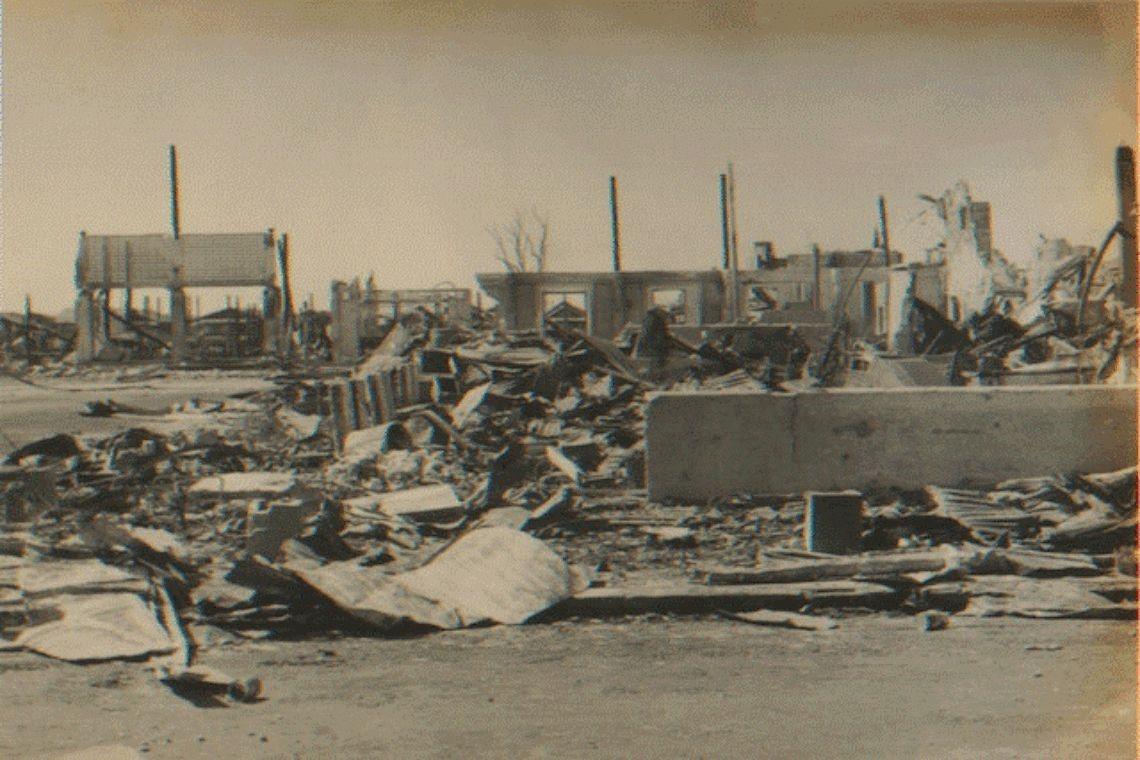
Photo of the aftermath of the Burning of Jolo in February 1974. Source: Minda News.
Proclamation No. 1081 placed the entire Philippines under Martial Law and gave the Armed Forces of the Philippines expanded powers to enforce government orders and suppress armed resistance. In Sulu, however, the effects were shaped by an already growing Moro movement and deep distrust between Muslim communities and the national government.
Research based on Tausug survivor testimonies shows how military expansion changed everyday life. Communities in the Sulu hinterlands faced checkpoints, searches, weapons confiscations and restrictions that affected farming and trade. Fruit growers and traders, for example, found it harder to move produce between rural areas and Jolo as military surveillance increased.
The experience also carried a cultural dimension. For many Tausug men, firearms were connected to honor, status and protection, meaning that confiscations were experienced not simply as security measures but as an assault on dignity and customary social practices. Survivor accounts also describe fear, disappearances and killings during the period, although individual incidents and responsibility require careful historical examination.
Martial Law did not create the Moro struggle from nothing. Anger had already been building over political marginalization, violence and the treatment of Muslim communities, including the 1968 Jabidah incident, which involved the killing of an estimated 200 young Moro Muslim recruits by military handlers on Corregidor Island. But the declaration of Martial Law helped push the conflict into a more open and militarized phase, while the Moro National Liberation Front (MNL) emerged as a major force in the southern Philippines.
For some Tausug, violence experienced by Muslims elsewhere in Mindanao strengthened the belief that peaceful appeals were failing. These experiences helped deepen support for the MNLF and encouraged some Tausug to see political self-determination and Islam as frameworks for protecting their communities.
The conflict reached a devastating point in February 1974, when fighting between government forces and the MNLF engulfed Jolo. Contemporary and later accounts differ over specific events, including the use of particular weapons and individual acts of destruction. The broader historical record, however, establishes that the fighting devastated large parts of the town and caused extensive civilian suffering and displacement.
"Jolo had been an important commercial and cultural center, and the violence disrupted livelihoods, trade and community networks."
The destruction went beyond buildings. Jolo had been an important commercial and cultural center, and the violence disrupted livelihoods, trade and community networks. For Tausug survivors, the event became a defining memory of the dangers created when armed conflict reaches civilian areas.
Updated headlines for free, straight to your inbox—no noise, just facts.
We collect your email only to send you updates. No third-party access. Ever. Your privacy matters. Read our Privacy Policy for full details.
The Jolo violence became part of a much larger conflict that eventually moved from armed struggle toward negotiations. In 1976, the Philippine government and the MNLF signed the Tripoli Agreement, beginning a political process centered on autonomy rather than the earlier demand for full separation. The 1996 Final Peace Agreement later sought to implement that settlement.
"The journey from battlefield confrontation to autonomous government did not erase the losses of the Martial Law years, but it demonstrated how the political struggle increasingly moved toward institutions and negotiations."
The peace process continued through separate negotiations with the Moro Islamic Liberation Front and eventually contributed to the creation of the Bangsamoro Autonomous Region in Muslim Mindanao. The journey from battlefield confrontation to autonomous government did not erase the losses of the Martial Law years, but it demonstrated how the political struggle increasingly moved toward institutions and negotiations. Even after the first election in BARMM in September 2026 showed that long-running political grievances increasingly are addressed through negotiation, political representation and autonomy rather than armed struggle.
Sulu’s history also shows the cost of allowing political and historical disputes to become armed conflicts. The violence that followed the declaration of Martial Law, the destruction of Jolo in 1974, decades of insurgency, and repeated displacement left deep economic and social damage. For communities that have lived through these experiences, the lesson is not that Sulu lacks causes worth defending, but that violence has repeatedly carried a heavy price for ordinary people.
Sulu’s history also raises a difficult question about what the legacy of the supposed heirs of the Sulu Sultanate should mean for the province today. Much of its recent public focus has centered on competing claims to the symbolic title of Sultan of Sulu and false claims to Sabah, while advocacy for Sulu’s hospitals, economic development and security has received comparatively less attention.
Sulu has already experienced the consequences of turning political and historical grievances into conflict. The historical impact of Martial Law brought displacement, insecurity and economic disruption to communities that were already vulnerable. The peace process that followed demonstrated that political grievances could be pursued through negotiation, autonomy and political institutions rather than continued violence. For that reason, the legacy of the Sulu Sultanate should not be used to pull Sulu back toward confrontation. Invoking false claims as a basis for renewed armed action risks repeating the very pattern that caused so much suffering in the first place.
"After decades of conflict, the clearest lesson from Sulu’s history is that its people have more to gain from peace than from another struggle fought in the name of the past."
Whatever legitimacy different members of the Kiram family believe they inherit from the Sultanate, that legacy should ultimately be measured by whether it contributes to the security and prosperity of the people of Sulu. A historical title cannot build a hospital, restore a school, connect an island community to a market or create a job. Peace and stable institutions can. Sulu does not need another generation drawn into violence over the politics of its past. . After decades of conflict, the clearest lesson from Sulu’s history is that its people have more to gain from peace than from another struggle fought in the name of the past.
REFRERENCES
Know Sulu (2026, September 17). No Majority, No Easy Government: What BARMM’s Election Means for Sulu. Know Sulu. https://know-sulu.ph
Office of the President of the Philippines. (1972, September 21). Proclamation No. 1081: Proclaiming a state of martial law in the Philippines. Lawphil. https://lawphil.net
Salomon, E. G. R. (2022). Testimonial narratives of Muslim Tausug: Against militarization in Sulu (1972–1974). Studia Islamika, 29(2), 241–270. https://studiaislamika.ppimcensis.or.id
Minda News (2024, February 21). PEACETALK: The Jolo Siege of 1974, half a century hence: Notes on history, war, peace, law and justice (2). Minda News. https://mindanews.com
University of the Philippines. (2026, September 20). UP Day of Remembrance: Commemorating the university's tradition of critical thinking, activism, and sacrifice for the Nation. https://up.edu.ph

KnowSulu is your trusted source for verified facts, news, and legal insights about the Sulu region. Committed to integrity, our mission is to empower the people of Sulu by providing accurate, transparent, and reliable information that matters.