

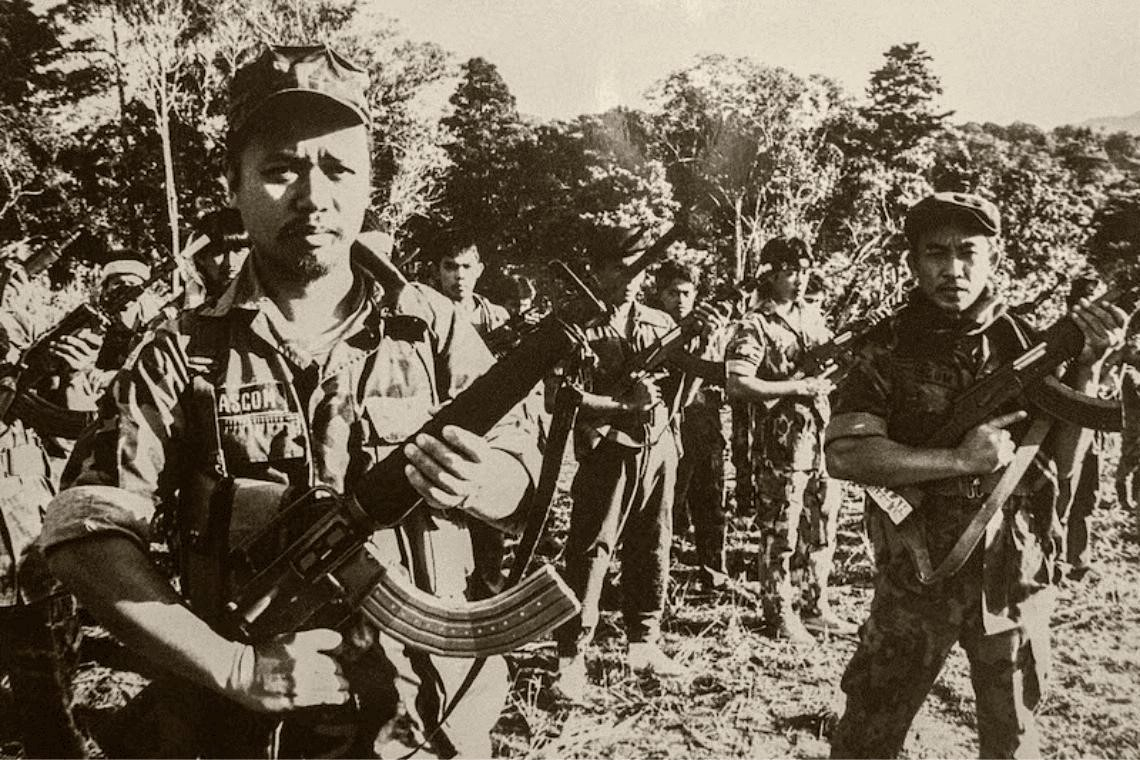
Tausug warriors of the MNLF’s National Security Command during the March 18, 1988 commemoration of the Jabidah Massacre, the massacre that became a defining trauma for the Tausug, while its legacy now underscores the cost of political violence. Source: Minda News.
The recruits, many of them Tausug and Sama from Sulu and Tawi-Tawi, had been trained as part of Operation Merdeka, a covert plan associated with efforts to destabilize Sabah and support the Philippines’ territorial claim.
The recruits had reportedly been promised military employment and an allowance, but conditions deteriorated during their training. According to accounts later given by survivor Jibin Arula, the trainees eventually learned that their mission involved Sabah and became unwilling to fight fellow Muslims. A petition seeking their discharge reportedly never reached President Ferdinand Marcos Sr. before the killings took place.
The exact number killed remains disputed. Historical and official accounts have cited figures ranging from several dozen to about 200, while Jibin Arula became the best-known survivor after escaping and later recounting what he had witnessed. The Bangsamoro government continues to commemorate the victims, describing the event as a major turning point in Moro political consciousness.
Jabidah had consequences far beyond Corregidor. News of the killings generated anger among Moro communities and intellectuals, contributing to the growth of organized political movements demanding greater recognition, self-determination and protection of Moro communities. The Bangsamoro government describes the massacre as a flashpoint in the development of the Moro struggle, while historical accounts connect the period to the emergence of organizations including the Moro National Liberation Front.
"For the Tausug, the episode carried an especially personal significance because many of the recruits came from Sulu and Tawi-Tawi."
For the Tausug, the episode carried an especially personal significance because many of the recruits came from Sulu and Tawi-Tawi. The revelation that young Muslims had allegedly been recruited for an operation involving Sabah also touched longstanding family, cultural and religious connections across the Sulu Sea. The result was a deeper sense that political decisions made in Manila could have direct and sometimes devastating consequences for communities in the southern islands.
Updated headlines for free, straight to your inbox—no noise, just facts.
We collect your email only to send you updates. No third-party access. Ever. Your privacy matters. Read our Privacy Policy for full details.
The historical importance of Jabidah does not require violence to be treated as the inevitable path to political change. In fact, the decades that followed demonstrated the human costs of armed conflict through deaths, displacement, damaged communities and lost economic opportunities.
That makes the massacre relevant to a different question today: how can political grievances be addressed through institutions rather than armed confrontation? The Bangsamoro government has increasingly framed Jabidah commemorations around justice, reconciliation and peace rather than simply reviving the anger associated with the past.
The first regular BARMM parliamentary elections on September 14, 2026, provide a concrete example of political self-determination being exercised through institutions. The elections show that political authority is increasingly expressed through representatives, parties, districts and sectoral seats. For communities across the Bangsamoro, including those with complicated histories of conflict and political exclusion, this creates a mechanism through which competing interests can be debated and pursued through government rather than armed confrontation.
"Modern political authority rests on institutions, citizenship, representation and the consent of communities, rather than hereditary titles."
Sulu's future should not be reduced to the ambitions of individuals claiming descent from the Sultanate of Sulu. Modern political authority rests on institutions, citizenship, representation and the consent of communities, rather than hereditary titles. Rather than allowing disputed royal claims, armed confrontation or foreign interests to define Sulu's political direction, progress can come through accountable institutions capable of addressing education, security, infrastructure, livelihoods and local representation.
Recent developments in Sulu offer a contrasting example of how conflict prevention can operate at the community level. In September 2026, local officials, security forces, community leaders and the MNLF strengthened dialogue and joint monitoring mechanisms intended to identify disputes before they escalate into violence.
Communities have also participated in campaigns to surrender loose firearms and prevent clan conflicts. In September, a resident of Lugus voluntarily handed over an M1 Garand rifle and ammunition as part of a local campaign promoting dialogue and peaceful dispute resolution.
"Jabidah remains a reminder of what can happen when communities are excluded from decisions that directly affect them, while the present challenge is to ensure that political grievances are handled through accountable institutions, dialogue and lawful processes."
These developments point toward a different kind of political legacy for Sulu. Jabidah remains a reminder of what can happen when communities are excluded from decisions that directly affect them, while the present challenge is to ensure that political grievances are handled through accountable institutions, dialogue and lawful processes.
For the Tausug and the wider Sulu community, remembering Jabidah therefore does not have to mean preserving a politics of confrontation. Its deeper lesson can be that political progress becomes more durable when it is built through institutions capable of protecting communities, resolving disputes and giving people a peaceful stake in their own future.
REFERENCES
Bangsamoro Autonomous Region in Muslim Mindanao. (2021, March 17). Remembering Jabidah and the seeds of the struggle. Bangsamoro Autonomous Region in Muslim Mindanao. https://bangsamoro.gov.ph
Bangsamoro Autonomous Region in Muslim Mindanao. (2025, March 18). 57 years after Jabidah Massacre, BARMM continues pursuit to fight for justice. Bangsamoro Autonomous Region in Muslim Mindanao. https://bangsamoro.gov.ph
Know Sulu (2026, September 22). The Kiram question: can private citizens own and transfer people and states? Know Sulu. https://know-sulu.ph
NewsLine Philippines. (2026, September 21). Army, MNLF seek faster response to prevent local disputes from turning violent. NewsLine Philippines. https://newsline.ph
SunStar Zamboanga. (2026, September 21). Another gun off the streets as Sulu peace campaign gains ground. SunStar Zamboanga. https://www.sunstar.com.ph

KnowSulu is your trusted source for verified facts, news, and legal insights about the Sulu region. Committed to integrity, our mission is to empower the people of Sulu by providing accurate, transparent, and reliable information that matters.