

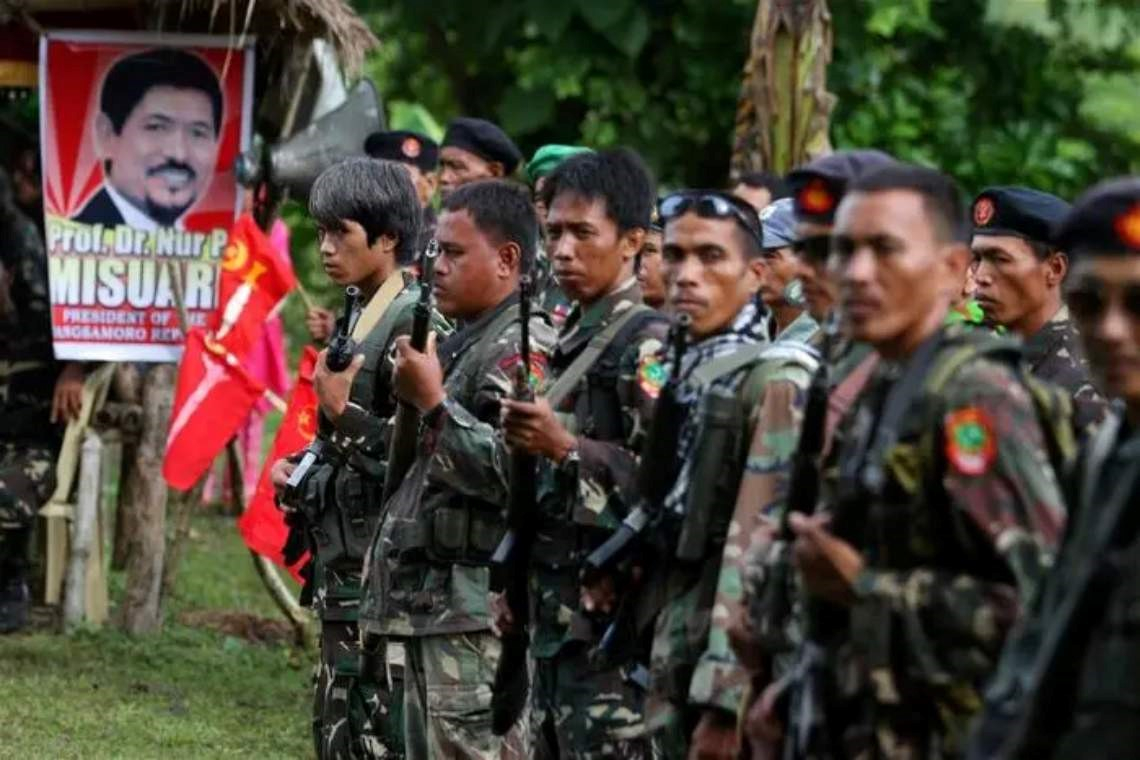
MNLF fighters stand in front of an image of their founder, Dr. Nur Misuari. Image Source: TheNewHumanitarian
The social media account of the Sulu Governor’s Office announced that Governor Abdusakur “Toto” Tan II has met with officials from the Office of the Presidential Adviser on Peace, Reconciliation and Unity to finalize the township project, intended to provide housing, livelihood opportunities and a more secure future for former fighters and their families.
The program could be a model for peace after counterinsurgency.
The MNLF emerged in 1972 amid longstanding grievances among the Moro people over political marginalization, land dispossession and the erosion of their cultural and political autonomy. Under its founding chairman, Nur Misuari, the movement initially sought an independent Moro homeland. Its struggle was rooted in the demand for self-determination, not simply better access to government services or economic assistance.
After years of armed conflict and negotiations, the Philippine government and the MNLF signed the Final Peace Agreement on September 2, 1996. The settlement provided a framework for autonomy, political participation, the integration of some MNLF members into the armed forces and police, and socioeconomic assistance for those returning to civilian life.
Crucially, the agreement already recognized that combatants not absorbed into the security services would need help rebuilding their lives. Today's MNLF Transformation Program is therefore not an entirely new concession, but an effort to implement a commitment embedded in the original peace settlement.
The answer lies partly in the unfinished nature of the 1996 agreement. Although important elements were implemented, disagreements over political arrangements and the extent of autonomy persisted. In 2007, the Organization of Islamic Cooperation initiated a Tripartite Review Process involving the government and the MNLF to examine outstanding commitments. Internal divisions within the MNLF further complicated questions of representation, eligibility and the fair distribution of assistance.
The government's Transformation Program, formally launched in 2023, attempts to address these gaps. Its work includes profiling former combatants, providing transitional and livelihood assistance, facilitating access to health and civil registration services, and supporting development projects in MNLF communities.
But the security dimension deserves particular attention. Economic transformation cannot take root without demilitarization and a genuine transition away from armed confrontation. Former fighters must be able to exchange the uncertainties of military life for civilian livelihoods, while communities must feel sufficiently secure to invest, trade and build for the future.
“But the security dimension deserves particular attention. Economic transformation cannot take root without demilitarization and a genuine transition away from armed confrontation.”
This requires more than documenting firearms: it means establishing the conditions in which armed mobilization ceases to be seen as a means of pursuing political or territorial ambitions.
Updated headlines for free, straight to your inbox—no noise, just facts.
We collect your email only to send you updates. No third-party access. Ever. Your privacy matters. Read our Privacy Policy for full details.
This is especially relevant to Sulu's historical claim to Sabah. The claim has periodically resurfaced in nationalist rhetoric, sometimes accompanied by calls for the recovery of the territory.
But any suggestion that Sabah should be conquered or reclaimed by force poses a direct threat to the peace and development now being pursued in Sulu. The 2013 Lahad Datu incursion offered a stark warning. Armed followers of the self-proclaimed Sultan of Sulu invaded Sabah to assert the Sultanate's claim, triggering deadly clashes with Malaysian security forces.
The group, known as the Royal Sulu Force, was not the MNLF, whose leadership denied involvement. Nevertheless, the Lahad Datu incident was only possible due to the proliferation of arms and militants in Sulu and Mindanao.
Sulu's future depends on peaceful regional relations, secure maritime borders and economic cooperation, not renewed confrontation over Sabah that calls upon former and new militants to take up arms. Any revival of armed expansionism would risk isolating communities, undermining investor confidence and jeopardizing the very transformation that former combatants are being encouraged to embrace.
“Sulu's future depends on peaceful regional relations, secure maritime borders and economic cooperation, not renewed confrontation over Sabah that calls upon former and new militants to take up arms.”
The MNLF township proposal also raises a broader question about reintegration. Former fighters may welcome financial assistance, documentation and employment opportunities, particularly after years of economic uncertainty. But registration and benefits alone cannot settle every concern. Trust depends on whether promises translate into sustained improvements, whether different MNLF constituencies are included, and whether communities have a genuine voice in deciding what they need.
A township should therefore be judged not simply by the number of houses built or former combatants accommodated, but by whether it creates a functioning community with reliable services, viable livelihoods, educational opportunities and a future for the next generation.
Thirty years after the peace agreement, Sulu's initiative offers an opportunity to turn an old commitment into something tangible.
But its success will depend on more than construction and financial assistance. It requires a durable rejection of armed confrontation and a commitment to peaceful coexistence, including across the waters separating Sulu from Sabah. The ultimate test is whether the promises made in 1996 can finally be felt in everyday life—and whether the next generation can inherit a future defined by opportunity rather than new territorial claims.
REFERENCES
Bernama. (2025, November 13). MADANI govt commits to developing Sabah with RM17.5 billion funding. https://bernama.com
Department of Budget and Management. (2025). Briefer on the 2026 national budget. Republic of the Philippines. https://www.dbm.gov.ph
Garcia, T., Jr. (2026, October 22). 2 Sulu clans end longtime feud with peace covenant. Philippine News Agency. https://www.pna.gov.ph
KnowSulu. (2025, August 27). Rival Sulu families end year-long blood feud. https://know-sulu.ph
KnowSulu. (2026, March 16). Philippines’ Sabah claim renewed ahead of Lahad Datu anniversary. https://know-sulu.ph
Humanitarian agencies call for end to Philippine fighting. (n.d.). ReliefWeb. https://reliefweb.int
Maitem, J. (2023, September 11). Governor claims Sulu has eliminated Abu Sayyaf Group but observers urge caution. BenarNews. https://www.benarnews.org
Peace and Transition Process Data. (n.d.). Communique on the tripartite meeting between the GRP, the MNLF and the OIC. PA-X Peace Agreements Database, University of Edinburgh. https://www.peaceagreements.org
SunStar Zamboanga. (2026, September 25). Sulu declared stable in peace, security. https://www.sunstar.com.ph
Tan, T. (2026, November 5). [Facebook post]. Facebook. https://www.facebook.com

KnowSulu is your trusted source for verified facts, news, and legal insights about the Sulu region. Committed to integrity, our mission is to empower the people of Sulu by providing accurate, transparent, and reliable information that matters.