

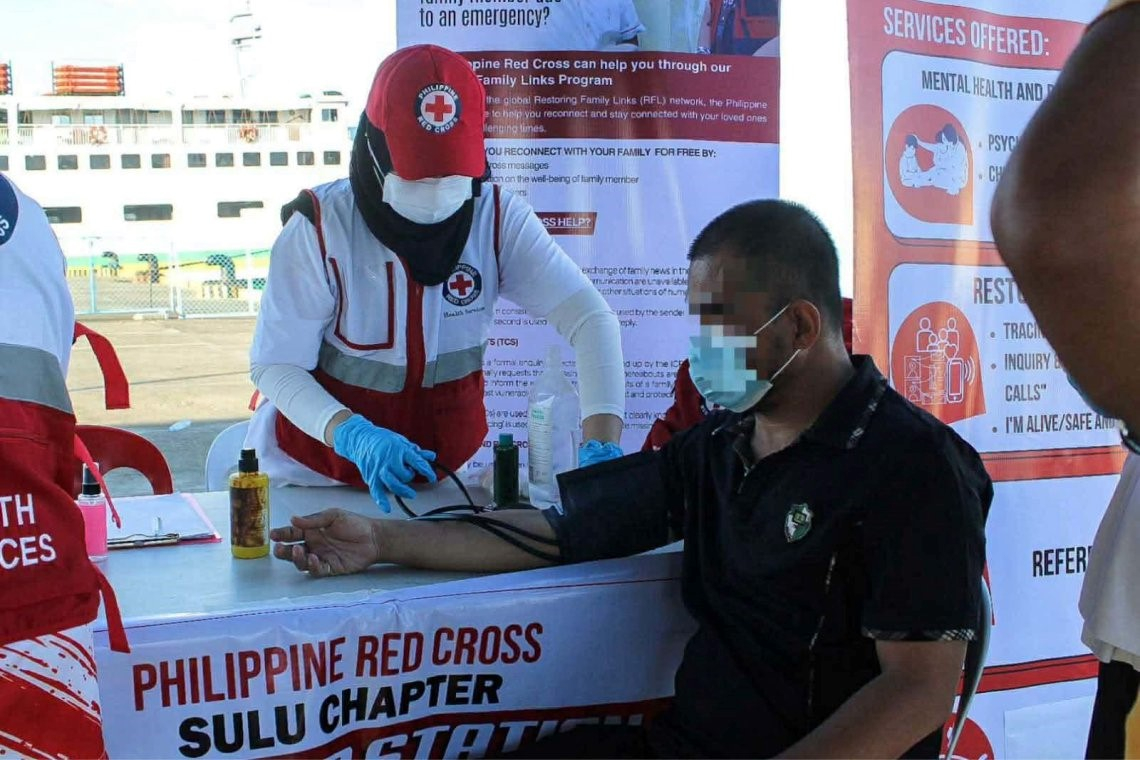
A Philippine Red Cross-Sulu Chapter volunteer checks the blood pressure of a Filipino returnee upon arrival at Jolo Port on November 9, 2026. Image Source: Philippine News Agency – Facebook.
The latest deportation operations in Sabah have brought renewed attention to the longstanding movement of Filipino communities between northern Borneo and the southern Philippines. Among the affected population are people with family, cultural and historical connections to the Sulu archipelago, where cross-border movement has shaped livelihoods and community relationships for generations.
On October 29, 2026, Sabah Immigration Department Director Datuk Sh Sitti Saleha Habib Yussof announced six large-scale repatriation operations involving approximately 800 Filipino detainees per week. The program aims to reduce overcrowding in immigration detention facilities and accelerate the removal of undocumented migrants. The first major group arrived at Zamboanga City Port on October 30, following transfers from detention centers in Sandakan, Papar and Tawau.
The 800 returnees included 589 adult men, 89 adult women and 122 children below the age of 12. The children comprised 64 boys and 58 girls. Their ages ranged from 16 days to 83 years across the deported population, illustrating the family dimension of the operation. A separate transfer of 269 Filipino detainees had already taken place on October 27, bringing the number repatriated during that week to 1,069.
The scale of the operation raises an important question for Sulu communities. Beyond the formal completion of deportation procedures, what happens to families returning to Philippine territory without secure accommodation, established livelihoods or sufficient resources to rebuild daily life?
The October arrivals were not an isolated development. On January 17, 2026, another group of 844 Filipinos arrived in Zamboanga from Sabah. Most came from Tawi-Tawi, while the remaining returnees originated from other parts of the region. The January operation demonstrated the logistical importance of Zamboanga as a reception point for people returning to island provinces across the southwestern Philippines. The October operation also revealed the scale of the support required. The Department of Social Welfare and Development (DSWD) transferred the arrivals to its Processing Center for Displaced Persons, where personnel conducted profiling and individual assessments. Food, essential personal items and assistance were provided, while partner organizations supported reception and welfare activities.
Updated headlines for free, straight to your inbox—no noise, just facts.
We collect your email only to send you updates. No third-party access. Ever. Your privacy matters. Read our Privacy Policy for full details.
The situation became particularly visible in Sulu on November 3, when 62 returning Filipinos from Sabah arrived at Jolo Port. The group included 11 minors. The Ministry of Social Services and Development (MSSD) Sulu and DSWD Field Office IX provided sleeping kits and initial financial assistance. A transportation allowance of PHP 3,000 was also distributed through DSWD IX, while profiling was scheduled to determine eligibility for further assistance. The November 9 operation provided another indication of the needs involved. Forty additional Filipinos repatriated from Sabah arrived at Jolo Port. The Philippine Red Cross assisted 19 individuals with medical and welfare services, including treatment for fever, dizziness, stomach pain and skin conditions. Psychological first aid, medical referrals and communication assistance were also provided.
“The situation became particularly visible in Sulu on November 3, when 62 returning Filipinos from Sabah arrived at Jolo Port.”
These interventions address immediate needs, but longer-term reintegration presents a different challenge. Families returning to island municipalities such as Tapul, Lugus, and Siasi may require transportation, housing, education arrangements and sustainable income. Children who have spent significant periods in Sabah may also face difficulties adjusting to new schools, particularly when documentation or previous educational records are incomplete. Available reports do not specify how many returnees are Tausug. However, the documented arrivals in Sulu confirm the direct impact of Sabah's deportation operations on communities across the archipelago.
The deportations also bring a sensitive historical distinction back into focus. The Sulu Claim is rooted in the historical relationship between the Sultanate of Sulu and North Borneo, now administered as Sabah by Malaysia. The Philippine government continues to maintain a sovereignty claim over Sabah. On February 20, 2026, the Department of Foreign Affairs reaffirmed that position, noting that Republic Act No. 12064 had not repealed the existing Philippine claim concerning North Borneo.
However, the territorial dispute and the immigration status of individual residents are separate legal and political questions. The historical relationship between Sulu and North Borneo does not automatically grant Filipino nationals permission to reside or work in Sabah under Malaysian immigration law. Likewise, deportation does not resolve the historical dispute or determine the legitimacy of competing territorial positions.
For Tausug families with ancestral connections across the Sulu Sea, the distinction is especially significant. Historical belonging, cultural identity and family ties can extend beyond present-day national boundaries, while immigration enforcement operates according to the laws and administrative systems of the states involved. This distinction places responsibility on Philippine institutions to address the circumstances of returning communities without confusing humanitarian assistance with territorial diplomacy. The DSWD, MSSD, local governments and humanitarian organizations have demonstrated an ability to coordinate reception, medical screening and initial financial support. The next question concerns the continuity of those services after the returnees leave processing facilities.
“The deportations also bring a sensitive historical distinction back into focus.”
The announced deportation program could bring thousands more Filipino nationals back to the Philippines. Sabah Immigration reported 6,165 Filipino detainees repatriated by November 8, out of 8,472 foreign nationals of various nationalities. These figures underline the scale of the movement, although they do not establish how many people originate from Sulu.
For Sulu, the significance of the 2026 deportation drive extends beyond immigration enforcement. The return of families with historical and cultural connections to the archipelago raises questions about reintegration, access to public services and the protection of vulnerable children. The Sabah dispute remains a matter of historical and diplomatic concern, but the immediate test for Sulu institutions is whether returning communities can rebuild stable lives after reaching home.
REFERENCES
Bernama. (2026, October 29). Sabah to repatriate 800 Filipino detainees weekly in six operations. Bernama. https://web26.bernama.com
DSWD Field Office IX-Zamboanga Peninsula - Facebook. (2026, January 17). DSWD-9 assists 844 returning Filipinos from Sabah. DSWD Field Office IX-Zamboanga Peninsula - Facebook. https://www.facebook.com
Radyo Pilipinas. (2026, November 3). 62 returning Filipinos mula Sabah, Malaysia, sinalubong ng MSSD Sulu sa Pantalan ng Jolo ngayong araw. Radyo Pilipinas.
Philippine News Agency - Facebook. (2026, November 9). Red Cross assists 40 repatriated Filipinos from Sabah. Philippine News Agency - Facebook. https://www.facebook.com
Borneo Post Online. (2026, November 8). 8,472 foreigners deported from Sabah to date, says Immigration Dept. Borneo Post Online. https://www.theborneopost.com

KnowSulu is your trusted source for verified facts, news, and legal insights about the Sulu region. Committed to integrity, our mission is to empower the people of Sulu by providing accurate, transparent, and reliable information that matters.