

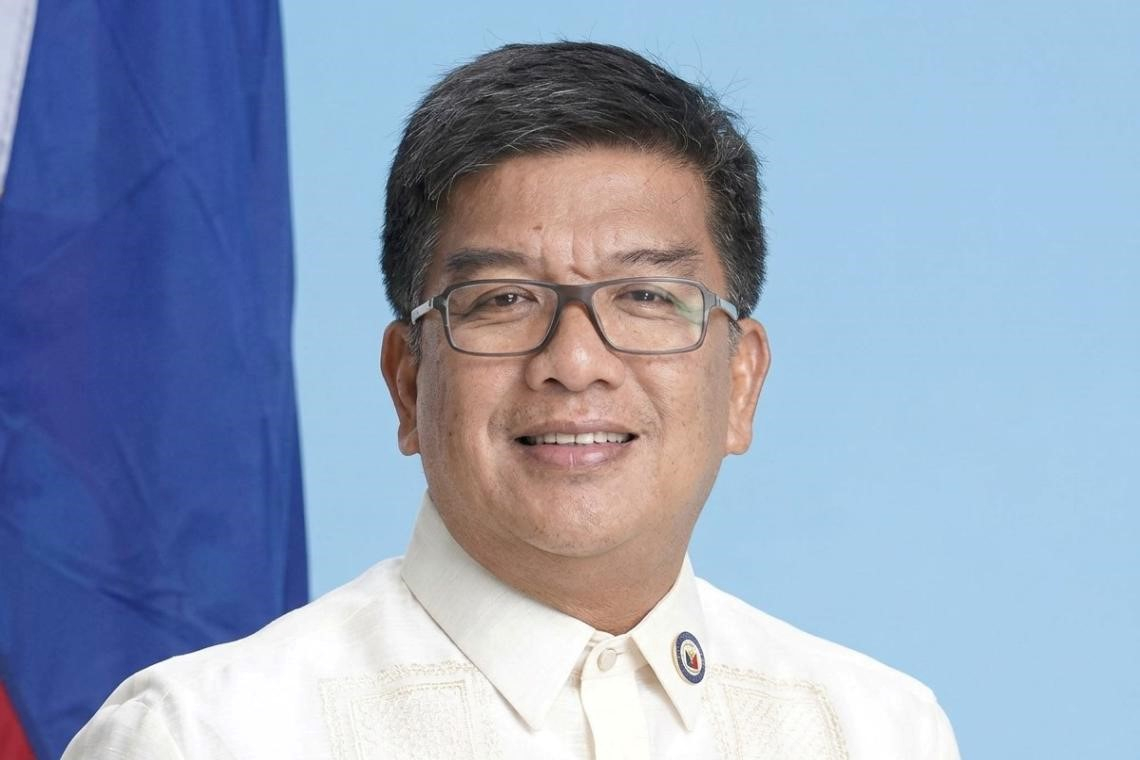
Basilan Governor Mujiv Hataman has raised the possibility of Sulu rejoining BARMM following its exclusion by the Supreme Court. Image Source : Manila Standard.
Sulu's relationship with the Bangsamoro Autonomous Region in Muslim Mindanao (BARMM) remains shaped by a fundamental question of political consent. Although the province shares historical, cultural and religious connections with the wider Bangsamoro community, its political position has followed a different path. The 2019 plebiscite, subsequent Supreme Court decisions and administrative separation from the region established a legal distinction that cannot be resolved through political statements alone.
The possibility of reconsidering BARMM membership, therefore, raises questions about self-determination, local representation and the conditions under which Sulu could participate in a regional autonomous government. These questions also intersect with the province's historical identity and the continuing relevance of the Sulu Sultanate's territorial claim.
The separation began with the January 21, 2019 plebiscite on Republic Act No. 11054, or the Bangsamoro Organic Law. In Sulu, 163,526 voters rejected its ratification, while 137,630 voted in favor. The result demonstrated that opposition to joining the new autonomous region extended beyond disagreements among provincial political leaders and reflected the expressed choice of a majority of participating voters. Despite this local result, Sulu initially became part of BARMM because the provinces and cities of the former Autonomous Region in Muslim Mindanao were counted as one geographical area under the law's implementation.
Sulu Governor Abdusakur A. Tan II challenged the province's inclusion before the Supreme Court. On September 9, 2024, the Court unanimously ruled that Sulu could not be included in BARMM because its voters had rejected the Organic Law. The decision upheld the validity of the Bangsamoro Organic Law itself while declaring its application to Sulu unconstitutional. The Court emphasized that the Constitution requires the consent of provinces, cities and geographical areas seeking inclusion in an autonomous region.
The Bangsamoro government subsequently sought reconsideration, arguing that excluding Sulu weakened historical and cultural connections within the Bangsamoro community. However, on November 26, 2024, the Supreme Court denied the motions for reconsideration and affirmed the exclusion with finality. The ruling established that shared identity and historical relationships cannot replace the constitutional requirement of local consent.
President Ferdinand Marcos Jr. formalized the administrative consequences through Executive Order No. 91, signed on July 30, 2025. The order declared Sulu part of Region IX, or the Zamboanga Peninsula, and established arrangements for the transfer of administrative responsibilities. It also recognized the need to protect existing programs, personnel and public services during the transition.
“The ruling established that shared identity and historical relationships cannot replace the constitutional requirement of local consent.”
Consequently, reconsidering BARMM membership would require a legally valid process rather than a reversal through executive preference or an informal agreement between regional leaders. Any future attempt at inclusion would require renewed consent from Sulu voters through a legally valid process, together with the appropriate constitutional and legislative measures.
Updated headlines for free, straight to your inbox—no noise, just facts.
We collect your email only to send you updates. No third-party access. Ever. Your privacy matters. Read our Privacy Policy for full details.
The political debate over Sulu's possible return to BARMM gained renewed attention on November 2, 2026, when Basilan Governor Mujiv Hataman expressed the possibility of the province rejoining the autonomous region under certain conditions. Speaking on Bilyonaryo News Channel's "Memo with Korina" program, Hataman said Sulu could reconsider membership if the newly elected Bangsamoro parliamentary government demonstrated effective governance, better public services and tangible economic benefits for residents.
Hataman also warned that the new regional government's performance could influence the position of other provinces, suggesting that effective governance could encourage Sulu to reconsider its position, while poor results might prompt other member provinces to consider leaving BARMM. His remarks placed public service delivery and institutional performance at the center of the debate rather than relying exclusively on historical and cultural ties.
The comments came shortly after the new Bangsamoro Parliament convened its inaugural session on October 30, 2026, following more than seven years of transitional governance. Hataman identified transparency, accountability and efficient public administration as essential priorities for the new government. He also pointed to persistent challenges, including private armed groups, unresolved clan conflicts and the incomplete normalization process under the Bangsamoro peace agreement.
In February 2026, the national government and BARMM convened a transition meeting to address funding and administrative arrangements, particularly in education and social protection. Discussions demonstrated that separation did not eliminate the need for cooperation between Sulu and Bangsamoro institutions.
A subsequent transition workshop held in June 2026 brought together the Department of the Interior and Local Government Region IX and the BARMM Ministry of the Interior and Local Government. The discussions covered programs, personnel, government assets and operational responsibilities. These discussions showed that the administrative separation required continued cooperation to protect essential services and affected public employees.
These arrangements illustrate an important distinction between administrative cooperation and political membership. BARMM can continue supporting development initiatives in Sulu without the province becoming part of its territorial jurisdiction. Indeed, the Bangsamoro government's June 2026 consultation with Sulu stakeholders focused on community development and explicitly distinguished the activity from a political or territorial discussion.
Any future reconsideration would, therefore, depend on whether residents believe regional autonomy could offer advantages that justify renewed membership. Relevant considerations include the quality of public services, education, healthcare, infrastructure, employment opportunities, fiscal arrangements and the ability of local institutions to represent Sulu's interests.
“Any future reconsideration would, therefore, depend on whether residents believe regional autonomy could offer advantages that justify renewed membership.”
The province's security situation also changes the political context. On September 24, 2026, Sulu was formally declared under a Stable Internal Peace and Security condition. Provincial officials reported that all 19 municipalities had been declared free of Abu Sayyaf presence following assessments by security agencies. This development strengthens the importance of evaluating future governance arrangements through the needs of a province seeking stability and sustainable development rather than through assumptions based on its conflict history.
The debate over BARMM membership also carries significance beyond administrative boundaries. Sulu's historical identity is closely connected to the Sultanate of Sulu, whose former territorial and political relationships continue to inform the Philippine claim to Sabah. The distinction between Bangsamoro regional autonomy and the historical Sulu claim is therefore essential.
The Bangsamoro peace process principally concerns political autonomy, governance and the settlement of a long-running conflict between Moro organizations and the Philippine government. The Sulu claim, by contrast, involves historical sovereignty, ancestral rights and the Philippines' diplomatic position concerning Sabah. Although these issues share historical connections, they do not constitute the same political objective.
For Sulu, this distinction also matters because the province's historical identity cannot be reduced to its relationship with the modern Bangsamoro autonomous institutions. The Sultanate of Sulu's historical connections to Sabah remain part of a broader political and diplomatic question involving the Philippines and Malaysia. However, the historical claim does not automatically determine whether Sulu should belong to BARMM. Decisions about regional membership concern the present-day political consent of residents, while the Sabah question involves a separate historical and international dimension. Keeping these issues distinct is essential to understanding why Sulu's relationship with BARMM remains politically sensitive.
A possible return to BARMM could reopen discussions about how Sulu's historical identity and interests would be represented within regional institutions. Such discussions would need to consider the province's distinct political experience, the 2019 rejection and the constitutional protections surrounding territorial inclusion. The interests of the Sulu royal family, local political leaders and ordinary residents should not automatically be treated as identical.
Ultimately, a reconsideration of BARMM membership would require more than renewed dialogue between the provincial and Bangsamoro governments. A credible process would need transparent consultations, clear institutional guarantees, public understanding of the legal consequences and a demonstrable willingness among Sulu voters to reconsider their earlier decision.
“A possible return to BARMM could reopen discussions about how Sulu's historical identity and interests would be represented within regional institutions.”
The central issue is not whether Sulu shares a Bangsamoro identity, but whether its population would freely choose to participate in the autonomous region under conditions that protect local representation, development priorities and historical interests. Until such political consent emerges through a lawful process, Sulu's position outside BARMM remains the governing legal reality.
REFERENCES
Supreme Court of the Philippines. (2024, September 9). SC upholds validity of Bangsamoro Organic Law; declares Sulu not part of Bangsamoro Region. Supreme Court of the Philippines. https://sc.judiciary.gov.ph
Supreme Court E-Library. (2024, November 26). G.R. No. 242255, Province of Sulu v. Executive Secretary. Supreme Court E-Library. https://elibrary.judiciary.gov.ph
The Lawphil Project. (2025, July 30). Executive Order No. 91. The Lawphil Project. https://lawphil.net
Presidential Communications Office. (2025, August 3). PBBM declares Sulu part of Zamboanga Peninsula; orders uninterrupted gov’t services. Presidential Communications Office. https://pco.gov.ph
Department of the Interior and Local Government Region IX. (2026, June 7). DILG IX, MILG-BARMM hold joint transition workshop for Sulu’s integration into Region IX. Department of the Interior and Local Government Region IX. https://region9.dilg.gov.ph
Bangsamoro Government. (2026, June 11). OOBC consults Sulu stakeholders to shape community-driven development agenda. Bangsamoro Government. https://bangsamoro.gov.ph
GMA News Online. (2026, September 25). Sulu turns page from decades of conflict. GMA News Online. https://www.gmanetwork.com
Bilyonaryo News Channel. (2026, November 2). Basilan gov sees Sulu’s possible return to BARMM. Bilyonaryo News Channel.
Presidential Communications Office. (2026, October 30). Speech by President Ferdinand R. Marcos Jr. at the 1st Session of the Bangsamoro Autonomous Region in Muslim Mindanao (BARMM) Parliament. Presidential Communications Office.
Department of Budget and Management. (2026, February 9). National Government, BARMM seal people-first transition plan to ensure uninterrupted services in Sulu. Department of Budget and Management.

KnowSulu is your trusted source for verified facts, news, and legal insights about the Sulu region. Committed to integrity, our mission is to empower the people of Sulu by providing accurate, transparent, and reliable information that matters.