

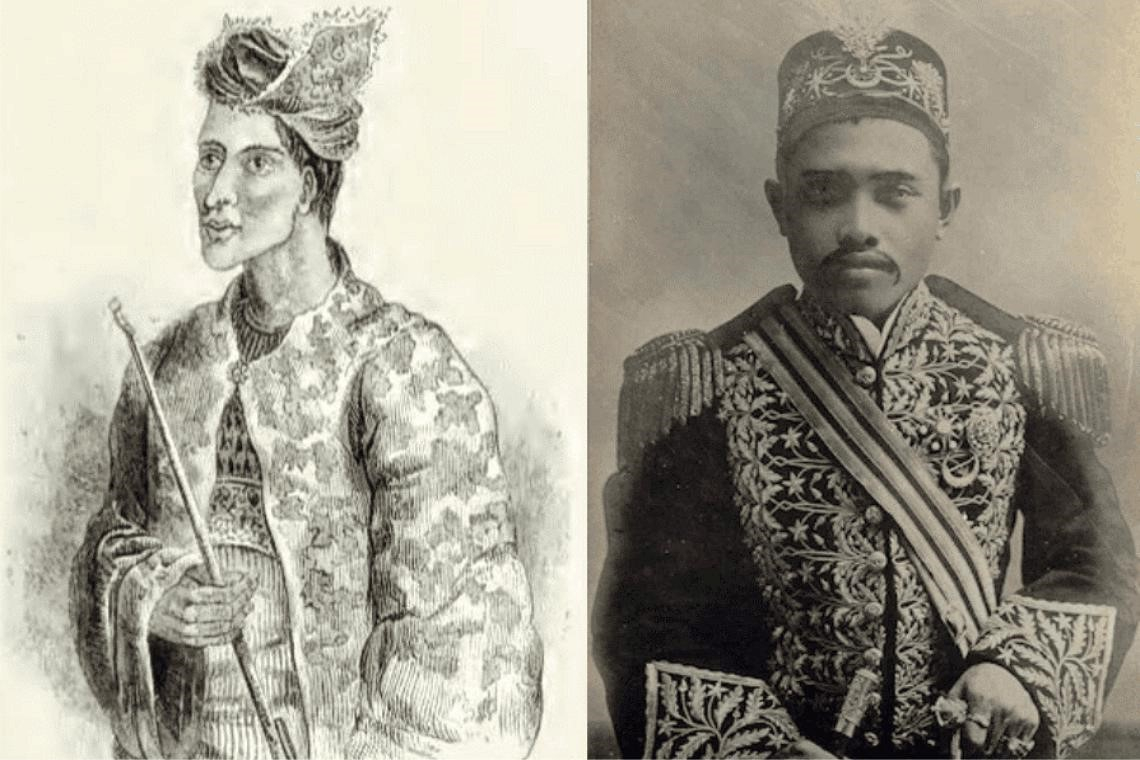
Portraits of Sultan Mohammad Pulalun Kiram’s and the last recognized ruler Jamalul Kiram II. Pulalun’s reign emphasized records, succession and diplomacy, while modern Sulu disputes have turned a colonial-era legacy into a multibillion-dollar legal battle. Source: Neldy Jolo.
His reign belonged to an era of colonial pressure and maritime conflict, yet his legacy also points to something strikingly different from today’s battles over the Sulu name: an effort to preserve institutions, records and political authority.
More than 160 years later, the Sulu name has become associated with a very different kind of international dispute. A $14.92 billion arbitration award against Malaysia was ultimately annulled in full by the Paris Court of Appeal on December 9, 2025, after years of litigation involving claimants, lawyers, funders and courts across several countries.
Pulalun’s reign coincided with an increasingly dangerous period for the Sulu Sultanate. French, Spanish and other European powers were expanding their military and commercial reach across Southeast Asia, while Sulu itself faced repeated naval attacks and pressure over its territory and trade. Historical accounts identify Pulalun as an administrator who began the Luntar, or Sulu Annals, in 1844.
The importance of the Luntar was more than historical record keeping. A written record of rulers, agreements and institutional affairs provided a means of establishing continuity in a political system increasingly challenged by outside powers. Pulalun’s diplomacy was therefore conducted in a world where sovereignty depended not only on military strength, but also on maintaining recognizable institutions and a defensible historical record.
"If the modern supposed heirs actually respected Pulalun’s Luntar, the throne would not be treated like an open-source title claimed by competing factions whenever large sums of money are involved."
Pulalun valued strict institutional clarity. Pulalun’s desire for strict codification stands in stark contrast with the modern reality, where the Sulu throne has splintered into a dozen different self-proclaimed sultans. If the modern supposed heirs actually respected Pulalun’s Luntar, the throne would not be treated like an open-source title claimed by competing factions whenever large sums of money are involved.
His reign was hardly peaceful. French forces pressured Sulu over Basilan in the 1840s, while Spanish military campaigns intensified later in the decade. By 1851, Spain had forced a major political settlement on the Sultanate after years of conflict, demonstrating the growing imbalance between European military technology and Sulu’s traditional maritime power.
Updated headlines for free, straight to your inbox—no noise, just facts.
We collect your email only to send you updates. No third-party access. Ever. Your privacy matters. Read our Privacy Policy for full details.
Pulalun died on September 24, 1862, and the succession continued through Jamal ul-Azam, followed by later rulers of the Kiram line. But the political institution changed dramatically during the following decades as Spanish, American and later Philippine authority progressively replaced the Sultanate’s independent political power.
"Modern claimants are essentially retroactively mapping themselves onto Pulalun's family tree to bypass the fact that the actual, cohesive political entity of the Sultanate ceased to exist nearly a century ago."
The crucial break came in 1936, when Sultan Jamalul Kiram II died without a son. His brother Muwallil Wasit II was proclaimed Sultan but died before his formal coronation, contributing to a succession crisis. Historical accounts record competing claimants in the years that followed, while the Philippine government did not recognize the Sultanate as a continuing sovereign political authority.
The existence of competing claims, however, illustrates how different the modern landscape is from the centralized political structure represented by Pulalun’s reign. The unbroken lineage tracing back to Pulalun completely shattered after the death of Sultan Jamalul Kiram II in 1936, who died without direct heirs. This structural break is what triggered decades of overlapping claims. Modern claimants are essentially retroactively mapping themselves onto Pulalun's family tree to bypass the fact that the actual, cohesive political entity of the Sultanate ceased to exist nearly a century ago.
The contrast became particularly sharp in the Sabah arbitration. Eight individuals claiming descent from Sultan Jamalul Kiram II pursued compensation from Malaysia based on the 1878 agreement involving North Borneo. An arbitrator eventually awarded them $14.92 billion in 2022, but the award became the subject of extensive challenges in Spain, the Netherlands and France. The legal story changed decisively in December 2025. The Paris Court of Appeal annulled the $14.92 billion award in its entirety and ordered the claimants to pay €200,000 in costs.
The case introduced a distinctly modern financial dimension. London-based litigation funder Therium financed the proceedings through multiple funding rounds, with more than $20 million spent on the case according to the claimants’ legal team. Therium's own description of litigation funding presents such financing as an investment in legal claims, with funders expecting a financial return if a case succeeds.
"The irony is, while Pulalun fought tooth and nail to keep European powers out of Sulu's internal sovereignty, modern "heirs" invited European arbitrators and British and American lawyers to weaponize colonial treaties for a payout."
When Sultan Pulalun dealt with European colonial powers, he did so to actively protect his people from total destruction. His diplomacy was rooted in regional survival. The supposed heirs of Sulu took a colonial-era land contract and turned it into a $15 billion speculative commercial lawsuit funded by elite Western litigation investors. The irony is, while Pulalun fought tooth and nail to keep European powers out of Sulu's internal sovereignty, modern "heirs" invited European arbitrators and British and American lawyers to weaponize colonial treaties for a payout.
REFERENCES
Global Arbitration News. (2026, January 27). The Paris Court of Appeal annuls USD 14.92 billion award against Malaysia. Global Arbitration News. https://www.globalarbitrationnews.com
Know Sulu. (2026, September 09). Kiram’s Oil and Gas Claims Expose a Selective View of Foreign Intervention. Know Sulu. https://know-sulu.ph
Know Sulu. (2025, June 06). FRAUD Kiram: The Royal Ruse of Professional Conmen, Fuad and Omar Kiram. Know Sulu. https://know-sulu.ph
Saleeby, N. M. (1908). The history of Sulu. Bureau of Public Printing. https://www.hellenicaworld.com

KnowSulu is your trusted source for verified facts, news, and legal insights about the Sulu region. Committed to integrity, our mission is to empower the people of Sulu by providing accurate, transparent, and reliable information that matters.